Online monitoring of black liquor precipitation using ultrasound sonication
Motivation
Black liquor, a by-product obtained from the kraft pulping process, is an aqueous suspension of spent cooking chemicals and organic compounds from wood. As part of the recovery cycle of the kraft pulping process, black liquor is first concentrated in multi-effect evaporators and then burned in recovery boilers to produce energy and recover the cooking chemicals. The high solid content in black liquor causes significant fouling during evaporation, adversely affecting the efficiency of the recovery process. An emerging solution to prevent fouling is to use ultrasound to promote crystal nucleation, growth & agglomeration, thereby avoiding scale formation on the heating surfaces of the evaporator. Using the Pixact Crystallization Monitoring (PCM) system, the real-time effect of ultrasound sonication on black liquor precipitation could be monitored.
Implementation
The Pixcell flow-through-cuvette measurement system is used for these measurements, with the analysis software being optimized for the optically thick black liquor solution. The black liquor to be measured is first heated to more than 100 °C in a nearby furnace and then inserted into the sample tank, to which the ultrasound sonicator is attached. After ensuring that the sample is circulating through the flow through cuvette using the Pixact analysis software, the ultrasound sonicator is activated.
Measurements are performed for:
a) sonicating the black liquor for different durations;
b) sonicating the black liquor at different temperatures;
c) sonicating the black liquor at different power ratings; and
d) using different types of black liquor.
Examples of the image data are shown in Figures 1A-C, and trends of particle size and number of particles are presented in Figure 2. When the ultrasonic sonication is initiated, a rapid increase in particle count and size is observed. After the ultrasound sonication is stopped, a gradual reduction in particle count is observed. However, the size of the particles continues to increase, indicating that the precipitated particles undergo growth as well as agglomeration.
Figure 1. Images taken during Black liquor precipitation. The scale bar corresponds to 500 µm.
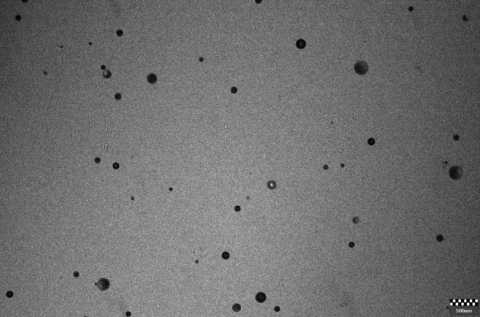

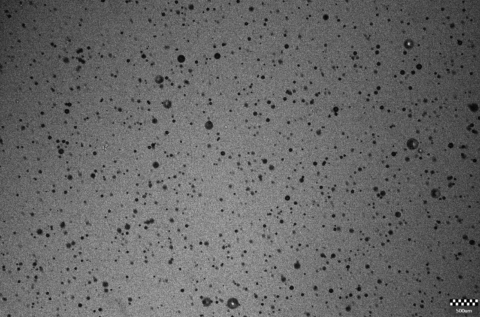

A parametric investigation shows that there exist optimal values of sonication duration and sonication power, beyond which the measured particle count does not increase in accordance with the sonication values. Higher temperatures promote microparticle formation due to the inverse solubility behavior of salts in black liquor.
Benefits
Black liquor is an extremely viscous liquid with very high solid content (> 50%), making it a very challenging medium for inline process microscopy. Furthermore, ultrasound sonication is inherently transient, thereby requiring real-time measurements to accurately quantify the process. Using Pixact’s PCM measurement system with trans-illumination and robust analysis software, it is possible to peer directly into the process and diagnose, in real-time, the efficacy of ultrasound.
Technical implementation
The PCM measurement system used in this measurement is of the Pixcell family. The illumination is provided by a high-power laser using the trans-illumination technique to ensure that the small crystals formed during sonication are accurately measured. A persitaltic pump is used to circulate the heated black liquor through the measurement system (Figure 3). The temperature of the circulating black liquor is measured using an inline thermocouple. The PCM analysis software is installed on a laptop. A summary of the specifications of the measurement system is presented in the table below.
| Nominal size | DN06 |
| Material | Stainless steel AISI316L |
| Setup | Direct optical imaging, Pixstrobe illumination unit, peristaltic pump, inline thermocouple |
| Process interface | Sapphire window |
| Sealing | FPM |


Figure 3. Implementation of PCM system
Acknowledgement
Pixact would like to thank the Separations Science Research Group at Lappeenranta University of Technology (Lahti campus) for the measurement data used in this application note.
Acknowledgement